What is a home equity loan?
A home equity loan lets you borrow against the value you have already built in your home. Instead of qualifying based primarily on your income and credit score, approval is based on the equity available in your property. That makes it one of the most accessible borrowing options for homeowners — including those who have been declined by their bank.
How much equity can you access?
Most lenders will let your total borrowing reach about 80% of your home's value. Here is what that looks like on a typical Alberta home:
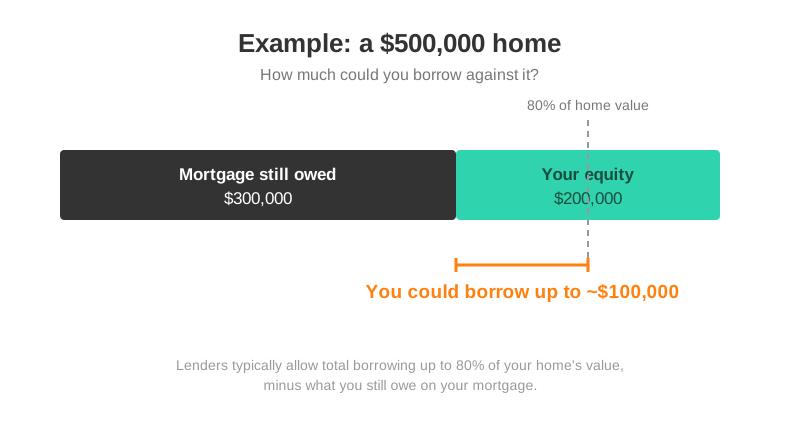
The stronger your equity position, the more room you have — and the better the available rates tend to be.
Access to larger amounts at lower rates
Because the loan is secured against your home, lenders can offer significantly larger amounts and lower interest rates than unsecured options like credit cards, personal loans, or payday lenders. If you are carrying balances at 20% or more, moving that debt against your home equity can dramatically reduce the interest you pay each month.
Consolidate high-interest debt into one payment
One of the most common reasons homeowners use a home equity loan is debt consolidation. Multiple credit card payments, car loans, and personal loans can be rolled into a single monthly payment — often lower than the combined payments you were making before. That simplifies your finances and frees up monthly cash flow.
Fund renovations that grow your home's value
Using equity to improve the property that secures the loan can be a smart cycle: a renovated kitchen, finished basement, or new roof often increases your home's market value, rebuilding the equity you borrowed. It is one of the few forms of borrowing that can directly pay for itself.

Renovations funded through home equity often increase the value securing the loan.
Approval based on equity, not just credit
Banks weigh income, employment history, and credit score heavily. Private and alternative lenders focus on the equity in your home. If you are self-employed, recovering from a credit setback, or between jobs, a home equity loan may be available when traditional financing is not. A common sense lending approach looks at the real asset — your home — rather than just a checklist.
Flexible use of funds
Unlike a car loan or a mortgage for a purchase, the funds from a home equity loan are yours to direct: an emergency expense, a tax bill, a business opportunity, education costs, or simply breathing room. You decide what matters most.
Comparing your borrowing options
The difference in cost between borrowing options is easiest to see side by side:
| Borrowing option | Typical rate | Secured? | Best for |
|---|---|---|---|
| Credit card | 19–24% | No | Small, short-term balances |
| Unsecured personal loan | 9–15% | No | Mid-size purchases |
| Home equity loan | 7–12% | Yes | Consolidation, renovations |
| Payday loan | 300%+ | No | Avoid if at all possible |
A quick example
A homeowner carrying $40,000 across three credit cards at 21% pays roughly $700/month in interest alone. The same balance on a home equity loan at 10% costs about $333/month — cutting the interest cost by more than half.
What you'll need to apply
Getting an answer is usually quick. Have these ready:
- A recent mortgage statement showing your current balance
- Your most recent property tax assessment
- Photo ID
- A rough idea of what you want to borrow and why
Common uses we see, in no particular order:
- Consolidating credit cards and personal loans
- Renovations and repairs (kitchens, roofs, basements)
- CRA tax bills and other time-sensitive obligations
- Helping family with a down payment
Is a home equity loan right for you?
A home equity loan is a serious financial commitment secured against your home, so it deserves careful consideration — but for many homeowners it is the most affordable and accessible way to borrow. If you would like to know how much equity you could unlock, contact us — getting an answer is quick and does not require a perfect credit score.